

Key Takeaways
- Start with the neighborhood and your daily routine, then compare individual homes.
- Test commute times at the hours you would actually travel.
- Visit a street more than once to assess traffic, noise, parking, and activity.
- Verify school assignments, taxes, fees, and development plans through current official sources.
- Use a simple scorecard so a memorable kitchen or backyard does not outweigh practical concerns.
Finding the right home in Dallas, Texas, involves more than comparing list prices, square footage, and polished listing photos. The better question is whether a neighborhood will work for your everyday life, including travel time, street activity, nearby services, monthly costs, and the changes that may happen nearby after you move in.
For buyers who want help connecting property details with neighborhood context, Dallas real estate experts The TXRE Group provide home-search resources and real estate guidance across Dallas, Houston, and surrounding Texas communities. The Txre Group works with residential and commercial real estate and reports more than $1 billion in career sales, giving buyers a useful local perspective when they need to compare homes beyond what appears in an online listing.
Why Listing Photos Tell Only Part of the Story
Listing photos aim to introduce a property, not document every detail. Wide-angle shots can distort room size, and a well-framed exterior image might omit nearby intersections, utility corridors, vacant lots, or commercial driveways. Photos can’t reveal block noise at 7:30 a.m., weekend guest parking, or afternoon sun issues in the backyard.
A midday visit is helpful but shouldn’t be your only one. Return during rush hours, after work, and on weekend evenings if possible. A street near a school may be quiet most of the day but busy during drop-offs and pickups. A home near restaurants offers convenience but may also bring evening traffic and parking challenges.
Start With a Clear Neighborhood Wish List
Before opening more listings, separate non-negotiables from preferences. This creates a consistent filter and helps prevent a beautiful house from pulling attention away from a location that does not support your routine.
Define the essentials
- Your maximum acceptable travel time to work, school, family, or frequent appointments.
- The home style, lot size, number of bedrooms, and outdoor space you truly need.
- Your comfort level with older homes, new construction, townhomes, condos, or planned communities.
- Access to groceries, parks, trails, medical care, restaurants, and other regular stops.
- The importance of sidewalks, transit options, highway access, or a quieter interior street.
Keep the list short enough to use. If every feature is a must-have, it becomes harder to make reasonable tradeoffs when comparing Dallas neighborhoods with different housing types and price points.
Compare the Daily Commute, Not Just Map Distance
Distance is only one part of a commute. Two homes that are similarly close to a workplace can produce very different travel experiences because of major intersections, school zones, highway access, construction, toll routes, and the availability of alternate roads. Test the trip at the times you expect to take it, rather than relying solely on a map estimate from midday.
Use a practical commute worksheet
- Record the morning drive time and the evening return time.
- Note whether the route depends on a toll road and estimate the recurring cost.
- Identify one or two backup routes for accidents, weather, or road work.
- Test common trips beyond work, such as visits to family, medical care, airports, or activities.
- Consider whether a future job change could make the location less convenient.
Check Noise, Traffic, and the Feel of the Street
Walk the block with your phone put away for a few minutes. Listen for traffic, rail activity, mechanical equipment, barking dogs, delivery activity, and nearby businesses. Notice whether cars move quickly, whether sidewalks are continuous, how street parking works, and whether lighting appears sufficient for your own comfort when you expect to be outside.
- Visit during daylight and walk around the immediate block.
- Return during a typical after-work period.
- Drive through on a weekend evening.
- Stand outside the home with the windows open if the seller permits it.
- Ask direct questions about recurring noise, parking patterns, and neighborhood events.
Review Schools and Everyday Public Services Carefully
Neighborhood names, mailing addresses, and school assignments do not always align. Families should verify attendance information directly instead of relying on a listing description. The Dallas ISD SchoolSite Locator allows users to view an address in relation to district attendance zones, while the district advises families to call a school to verify enrollment information.
School research should reflect a household’s own priorities. Also look at practical services that shape daily life, such as library access, parks, recreation facilities, trash collection, fire stations, and the distance to routine medical care. These details may not be exciting during a showing, but they can matter for years after closing.
Look Beyond the Home at Future Development
Vacant land, an aging retail center, or a broad roadway can change over time. Before making an offer, review local zoning information, public meeting agendas, road proposals, and visible construction activity around the property. Development can add stores, services, housing, or improved infrastructure, but it can also bring temporary construction noise, changed views, and different traffic patterns.
For a property-level starting point, the Dallas Central Appraisal District property search lets users search parcels by address and view public assessment and jurisdiction information. Treat map boundaries and displayed data as informational, then confirm anything material to your purchase through the appropriate authority, survey, inspection, or title process.
Use Market Data Without Letting It Make the Decision
Market data can help you recognize whether a home is positioned competitively, but citywide numbers cannot decide whether one particular block is right for you. Compare homes with similar age, condition, size, lot characteristics, and location. A renovated home on a busy street is not automatically comparable to a similarly sized home on a quiet interior lot.
During your review, consider recent comparable sales, time on market, price reductions, seller concessions, property taxes, homeowners association fees, insurance, and likely maintenance. A lower purchase price can lose its advantage if recurring costs or near-term repairs strain the budget.
Build a Simple Neighborhood Scorecard
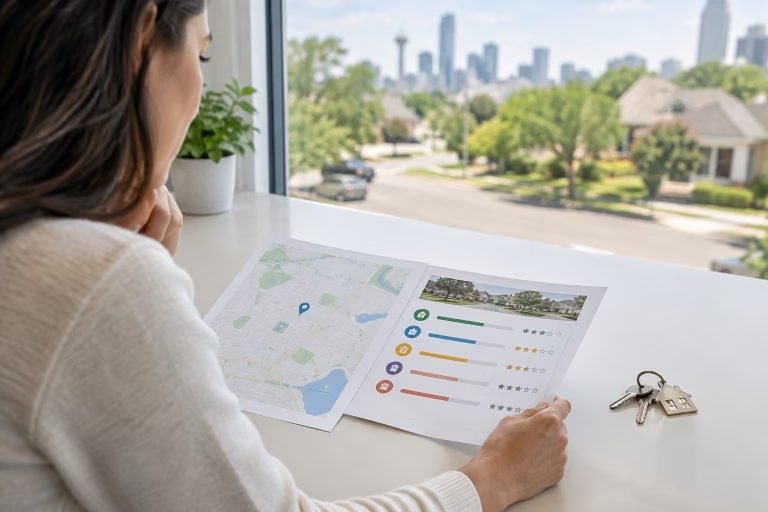
After each visit, rate each category from one to five and write a sentence explaining the score. The explanation matters because it captures details that may fade after touring several homes.
- Commute: How manageable are the usual routes at peak travel times?
- Daily services: Are groceries, parks, medical care, and other essentials reasonably accessible?
- Street feel: Do traffic, parking, sidewalks, lighting, and noise match your preferences?
- Future plans: Are nearby projects likely to improve convenience, create disruption, or remain uncertain?
- Monthly cost: Do taxes, insurance, fees, utilities, and maintenance fit comfortably within the budget?
A Practical Three-Day Neighborhood Check
- Day one: Drive the morning route and observe traffic, noise, and school-related activity.
- Day two: Visit after work, run a nearby errand, and check parking, sidewalks, and local services.
- Day three: Return on an evening or weekend to see how the area changes outside the normal workday.
Final Checklist Before Making an Offer
- Confirm estimated monthly ownership costs, not just the mortgage payment.
- Review homeowners’ association documents, restrictions, and fees where applicable.
- Verify school attendance information through the relevant district.
- Investigate drainage, floodplain, foundation, and insurance questions with qualified professionals.
- Review nearby zoning, development, and road plans.
- Drive the routes you will use most often.
- Compare the property with recent, genuinely similar sales.
- Schedule inspections and raise concerns before contract deadlines.
Conclusion
The right Dallas home should work on an ordinary Tuesday, not only during a well-staged tour. By testing the commute, visiting at different times, checking official information, and keeping a written neighborhood scorecard, buyers can make a decision based on the full experience of living there rather than on a strong first impression alone.